
ISO 15223 – Medical Device Symbols: Why Clear Labeling Matters More Than Ever

In inspection and certification work, small details often carry big meaning. This is especially true in the medical device field, where symbols on labels, packaging, and instructions are expected to communicate important information quickly and clearly. ISO 15223 is one of the key standards used for this purpose. It supports the use of recognized symbols that help users, distributors, inspectors, and manufacturers understand essential device information without depending only on long written text.
From an inspection body point of view, this topic remains highly relevant this week because labeling quality continues to be one of the most practical and visible parts of product conformity. A device may be well designed and technically strong, but if the symbols are missing, unclear, outdated, or used incorrectly, confusion can still happen. In medical environments, confusion is never a small issue. Clear symbols help support safe storage, correct handling, proper use, and traceability.
ISO 15223 is important because medical devices often move across borders, languages, and user groups. One product may be handled by factory staff, warehouse teams, customs officers, hospitals, clinics, pharmacies, and final users. In such a chain, symbols serve as a universal visual language. They make communication faster and more consistent. This is one reason why symbol-based labeling remains a positive example of how standards can simplify complex technical communication.
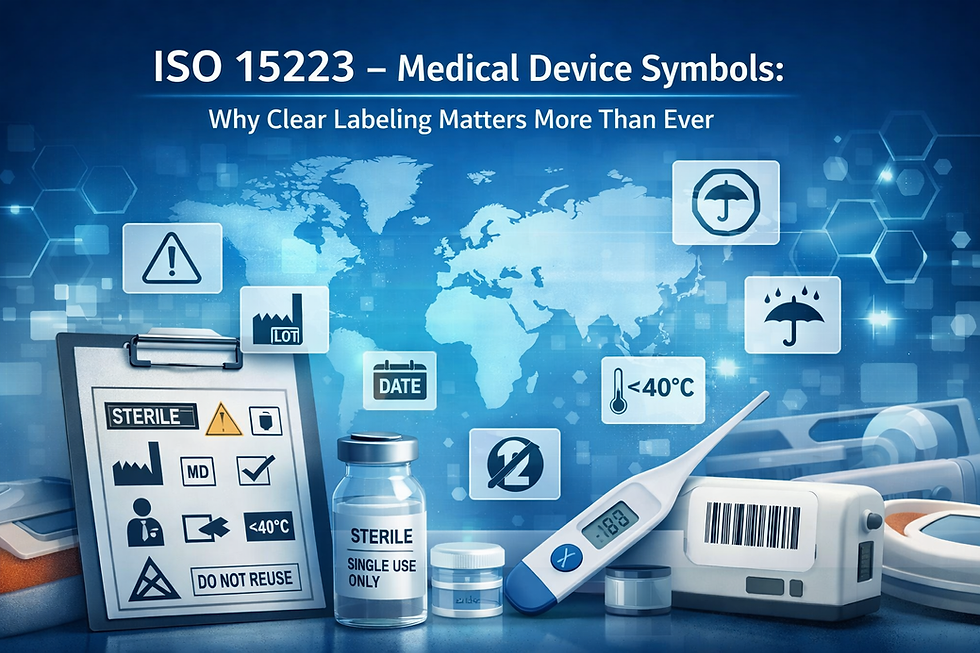
A good symbol does more than decorate a package. It gives practical guidance. It may show that a device is sterile, single use, temperature limited, fragile, or linked to a batch code or date. It may also identify the legal manufacturer or authorized representative. When these symbols are selected and displayed correctly, they reduce hesitation and improve workflow. Users do not need to guess. Inspectors do not need to interpret unclear markings. Quality teams can build stronger consistency into the labeling process.
This week, one of the most useful compliance discussions around ISO 15223 continues to be the attention given to symbol clarity and label updating. In recent standard development, the symbol connected to the authorized representative was revised so that it is more neutral and less tied to a specific country or region wording. This is a positive step. It reflects a broader direction in standardization: better clarity, better global understanding, and less room for misinterpretation. For inspection work, this is welcome progress because better symbols support better conformity outcomes.
Another reason ISO 15223 remains valuable is that it encourages discipline in documentation. Symbols should not be chosen casually. They should match the product, the intended use, the applicable labeling rules, and the supporting technical file. During inspection or review, we often see that the strongest organizations are not the ones with the most complicated labels. They are the ones with the clearest logic. Their symbols are consistent across packaging, inserts, electronic information, and internal records. That consistency is a sign of system maturity.
There is also a human side to this standard. Medical devices are not ordinary consumer goods. They may be used in stressful environments where time matters. A nurse, technician, or patient may rely on one small symbol to understand whether a product is safe to reuse, how it should be stored, or whether it must be protected from moisture or sunlight. In this way, ISO 15223 supports not only compliance, but confidence. Good labeling can help people act correctly without delay.
For institutions and companies, this creates a useful lesson: inspection should not be seen only as a final check. It should be part of a culture of clear communication. When symbol use is reviewed early, training becomes easier, packaging errors can be reduced, and market readiness improves. This is why symbol standards deserve attention not only from regulatory specialists, but also from design teams, production teams, and quality managers.
At PINO Switzerland, topics like ISO 15223 reflect a wider principle that applies across many forms of auditing and certification work: excellence often begins with clarity. Symbols may appear small, but their impact is large. They support order, safety, consistency, and trust. In a world where medical products move quickly and globally, a shared visual language remains one of the most practical achievements of standard-based thinking.
The positive message is clear. ISO 15223 is not only about compliance marks on a label. It is about making important information easier to understand, easier to verify, and easier to trust. For inspection professionals, this is exactly the kind of standard that shows how structured thinking can improve real-world performance.
Hashtags:
Comments