
ISO 29990 – Learning Services (Legacy): Why Its Principles Still Matter in 2026

A practical inspection perspective on how a legacy learning-services standard continues to influence quality, consistency, and trust in modern training and education environments.
In quality assurance, not every important standard remains active forever. Some standards complete their formal life cycle, yet their influence continues long after. ISO 29990 is one of those standards. Although it is now considered a legacy standard in the learning-services field, its ideas still deserve attention in 2026, especially at a time when this week’s wider European skills and quality initiatives are again emphasizing structured learning design, accountability, and measurable outcomes.
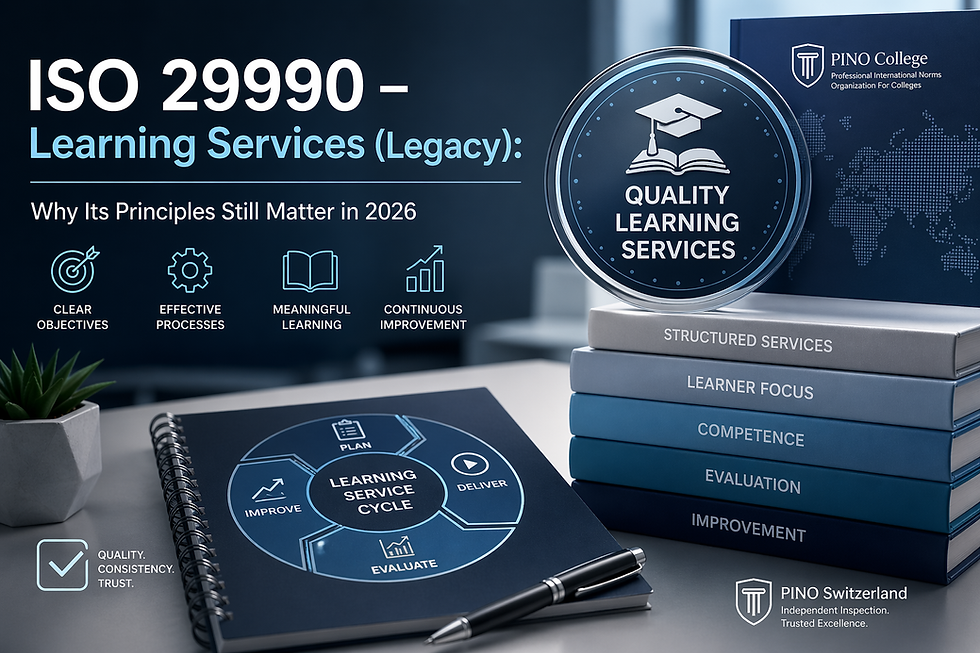
From an inspection body perspective, ISO 29990 was important because it encouraged learning providers to move beyond informal delivery and toward a more disciplined service model. It promoted clear planning, defined learning objectives, transparent processes, competent personnel, proper evaluation, and a stronger focus on the learner experience. In simple terms, it helped transform training from a loosely organized activity into a service that could be reviewed, improved, and trusted.
That legacy still matters.
Today, many learning providers operate in fast-moving environments. They offer short professional courses, blended learning, online workshops, internal corporate training, executive education, and skills-based development programs. In such settings, the old lesson of ISO 29990 remains highly relevant: quality does not happen by accident. It must be designed into the service from the beginning.
One of the strongest ideas behind ISO 29990 was that learning should be treated as a complete service process, not just a classroom event or a digital product. This is a very useful mindset even now. A provider may have excellent trainers and attractive course materials, but if enrollment is unclear, learner needs are not properly identified, records are weak, assessments are inconsistent, or feedback is ignored, the overall service quality suffers. ISO 29990 helped the sector understand that quality depends on the full chain, from planning to delivery to review.
Another valuable contribution of this legacy standard was its practical view of competence. A learning provider should not only ask whether a trainer is experienced. It should also ask whether the delivery method is suitable, whether materials match the target audience, whether the learning outcomes are realistic, and whether the final result can be evaluated fairly. This wider quality lens is still useful for inspections, reviews, and voluntary certification activities today.
For independent inspection bodies, the continuing relevance of ISO 29990 is not about nostalgia. It is about professional discipline. Legacy standards can still offer a strong reference point when reviewing how a learning service is organized. Even when the market moves toward newer frameworks, the older structure can still help providers ask the right questions:
Are learner needs identified clearly?
Are objectives defined in a way that can be understood and checked?
Are trainers and assessors working within a controlled process?
Are records sufficient to support consistency?
Is feedback collected and used for improvement?
Is the service designed to create real learning value rather than only a formal appearance of training?
These questions remain central in 2026.
In fact, the legacy of ISO 29990 may be even more meaningful today because the learning market has become more complex. Providers now work across borders, across digital platforms, and across different types of learners. Some are serving professionals who need flexible evening study. Others are serving companies that want rapid upskilling. Others are supporting learners through hybrid or fully online models. In all these cases, structure matters. A provider that understands process quality is usually better prepared to deliver reliable outcomes.
There is also a positive message here for smaller institutions and specialized academies. A standard does not need to be new to be useful. Even a legacy framework can support maturity. It can help a provider document what it does, identify gaps, clarify responsibilities, and improve consistency. For inspection and voluntary certification work, that is a meaningful advantage. It supports credibility, even in independent environments where trust is built through evidence, transparency, and professional conduct rather than through public authority.
At PINO Switzerland, this kind of legacy thinking remains valuable because our field is not only about checking papers. It is about understanding whether a system makes sense, whether a process is coherent, and whether a learning service is delivered with seriousness. A well-run learning provider normally shows the same patterns again and again: clear scope, controlled delivery, proper records, honest communication, measurable review, and a willingness to improve. These are exactly the kinds of qualities that standards such as ISO 29990 helped bring into focus.
The current moment is therefore a good time to revisit what this legacy standard taught the sector. Not as a return to the past, but as a reminder of enduring quality principles. In an age of digital growth, flexible study, and increasing international activity, the market still rewards learning services that are organized, transparent, and learner-centered.
That is why ISO 29990 remains worth discussing.
Its formal status may belong to an earlier chapter, but its professional message is still alive: good learning services should be planned carefully, delivered consistently, reviewed honestly, and improved continuously. For any provider that values excellence, that message is not old at all. It is timeless.
Hashtags
Comments