
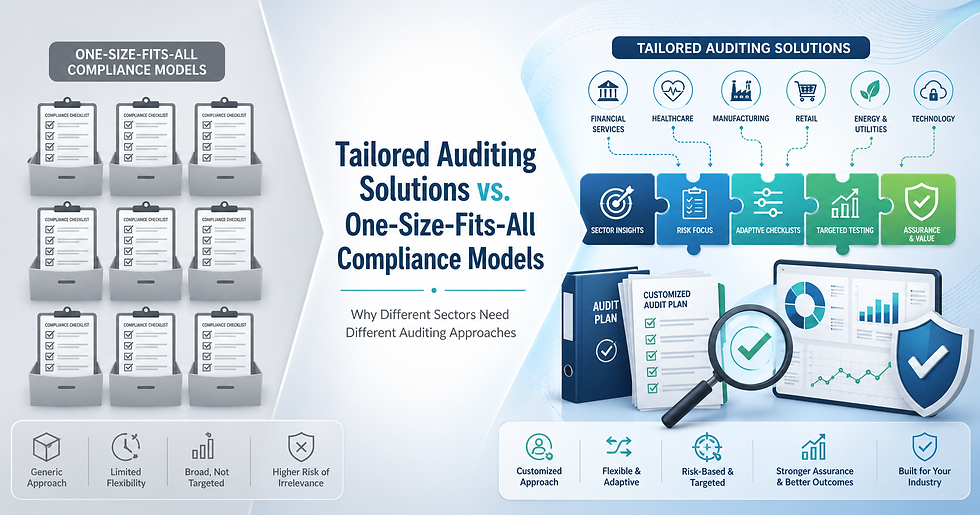
Tailored Auditing Solutions vs. One-Size-Fits-All Compliance Models

In today’s fast-changing business world, auditing is no longer only about checking documents and confirming that rules are followed. It has become an important tool for improving quality, building trust, reducing risks, and helping organizations grow in a responsible way. Because every organization is different, the auditing process should also be adapted to its real needs, activities, size, risks, and goals.
A one-size-fits-all compliance model may look simple, but it often cannot reflect the full reality of an organization. Different sectors face different challenges. A training provider, a manufacturing company, a healthcare service, a hospitality business, and a technology company do not operate in the same way. Each one has its own processes, responsibilities, risks, legal requirements, quality expectations, and stakeholder needs. This is why tailored auditing solutions are becoming more important.
What Is a One-Size-Fits-All Compliance Model?
A one-size-fits-all compliance model uses the same checklist, same method, and same evaluation style for every organization. It may focus mainly on whether certain documents exist or whether basic requirements are met. This approach can be useful for simple checks, especially when the goal is only to confirm minimum compliance.
However, it may not always provide deep value. If an audit does not consider the specific nature of the organization, it may miss important risks or improvement opportunities. It may also create unnecessary pressure by asking for documents or procedures that are not suitable for the organization’s real work.
For example, a small service provider may not need the same complex internal control structure as a large international company. A digital education provider may need a strong focus on online learning quality, student support, data protection, and digital systems, while a manufacturing company may need more attention to production safety, environmental impact, supply chain controls, and product quality.
When the same model is applied to all, the result may be formal compliance, but not always meaningful improvement.
What Are Tailored Auditing Solutions?
Tailored auditing solutions are designed around the specific needs of each organization. This does not mean lowering standards. On the contrary, it means applying standards in a smarter, more relevant, and more practical way.
A tailored audit looks at the organization’s sector, size, structure, services, risks, legal environment, internal culture, and long-term objectives. It asks: What matters most for this organization? Where are the real risks? Which controls are necessary? Which processes need improvement? What kind of evidence is most relevant?
This approach makes auditing more useful, fair, and effective. It helps organizations understand not only whether they comply, but also how they can improve.
Why Tailored Auditing Is More Effective
The main strength of tailored auditing is relevance. An audit becomes more valuable when it reflects the actual work of the organization. Instead of forcing every organization into the same structure, the auditor studies the context and builds an approach that fits.
This allows the audit to focus on meaningful areas. For example, an organization providing professional training may need careful review of course design, learning outcomes, assessment methods, learner feedback, trainer qualifications, and quality assurance procedures. A logistics company may need more attention to operational efficiency, safety controls, supplier management, and risk planning.
Tailored auditing also supports better communication. When the audit process speaks the language of the sector, managers and staff can better understand the findings. They are more likely to see the audit as a helpful tool, not just as an administrative requirement.
Different Sectors Have Different Needs
Every sector has its own priorities. This is one of the clearest reasons why customized auditing is important.
In education and training, quality may depend on curriculum design, learner support, academic integrity, assessment fairness, digital learning tools, and continuous improvement. In healthcare-related services, the focus may be on safety, confidentiality, professional competence, and service reliability. In hospitality, the audit may focus on customer experience, hygiene, staff training, service consistency, and operational quality. In technology, important areas may include information security, data management, system reliability, and innovation controls.
Even within the same sector, organizations can be very different. A small local provider and a large international provider may need different audit plans. A new organization may need guidance on building systems, while a mature organization may need deeper analysis of performance, risk management, and strategic improvement.
A tailored approach respects these differences.
Tailored Auditing Supports Improvement, Not Only Control
A good audit should not only identify gaps. It should also support improvement. Tailored auditing helps organizations see where they are strong and where they can become stronger.
Instead of producing a general report with standard comments, a customized audit can provide practical recommendations. These recommendations are more useful because they are connected to the organization’s real operations.
For example, instead of simply saying “improve documentation,” a tailored audit may explain which documents are needed, why they matter, who should maintain them, and how they can support daily work. Instead of saying “strengthen quality assurance,” it may suggest practical steps such as clearer internal review cycles, better feedback collection, stronger staff training records, or improved risk monitoring.
This makes the audit more positive and constructive.
Flexibility Does Not Mean Weakness
Some people may think that customized auditing means being less strict. This is not correct. Tailored auditing does not remove requirements or reduce quality. It applies requirements in a way that makes sense for the organization.
Strong auditing always needs independence, objectivity, evidence, and professional judgment. A tailored audit still follows clear criteria and standards. The difference is that the audit plan, evidence review, interviews, and recommendations are designed according to the organization’s context.
This creates a better balance between compliance and practicality. The organization is still expected to meet requirements, but the audit does not become a mechanical exercise.
Better Risk Management Through Customization
Risk is not the same for every organization. A one-size-fits-all model may treat all risks as equal, but real business life is more complex. Tailored auditing helps identify the risks that matter most.
For some organizations, the biggest risk may be data protection. For others, it may be financial control, staff training, customer safety, environmental responsibility, operational continuity, or regulatory compliance. A customized audit can give more attention to high-risk areas and less attention to areas that are less relevant.
This makes the audit more efficient and more useful. It also helps management make better decisions. When risks are clearly identified and explained, the organization can take action early and avoid bigger problems in the future.
A More Human and Practical Audit Experience
Auditing should be professional, but it should also be understandable. Tailored auditing creates a more human experience because it considers the real people, systems, and pressures inside the organization.
Staff members are more open when they feel the audit is fair and relevant. Managers are more willing to act on recommendations when they understand the practical value. The audit becomes a conversation about quality and improvement, not only a formal inspection.
This positive approach can build stronger trust between auditors and organizations. It also encourages a culture of continuous improvement.
The Role of Consultation in Tailored Auditing
Many organizations need more than a checklist. They need guidance, explanation, and practical advice. Tailored consultation can help organizations understand standards, prepare evidence, improve internal systems, and build stronger quality processes.
Consultation does not replace independent auditing, but it can support organizations before or after the audit process. It can help them understand what needs to be improved and how to take action in a realistic way.
This is especially useful for growing organizations, new institutions, and companies working across different countries or sectors. Customized guidance helps them avoid confusion and build systems that are both compliant and practical.
Why the Future of Auditing Is More Personalized
As organizations become more digital, international, and specialized, auditing must also become more flexible and intelligent. Standard models will still have a place, especially for basic compliance checks. But the future of auditing is moving toward deeper understanding, sector-specific knowledge, risk-based planning, and customized improvement strategies.
Tailored auditing solutions help organizations save time, reduce unnecessary complexity, and focus on what truly matters. They also make audits more valuable because the results are connected to real performance and future development.
Conclusion
A one-size-fits-all compliance model may offer simplicity, but it often cannot capture the real needs of different sectors and organizations. Tailored auditing solutions provide a more effective, practical, and positive approach. They respect the uniqueness of each organization while still supporting strong standards, accountability, and continuous improvement.
Every organization has its own structure, challenges, risks, and goals. For this reason, auditing should not be limited to a fixed checklist. It should be a professional process that understands context, supports quality, and helps organizations move forward with confidence.
Tailored auditing is not only about compliance. It is about building better systems, improving trust, and creating long-term value.
Sources
International auditing and quality management principles
General compliance and risk management practice
Professional quality assurance and internal audit guidance
Comments