
How Auditing Supports Long-Term Business Growth, Not Just Compliance

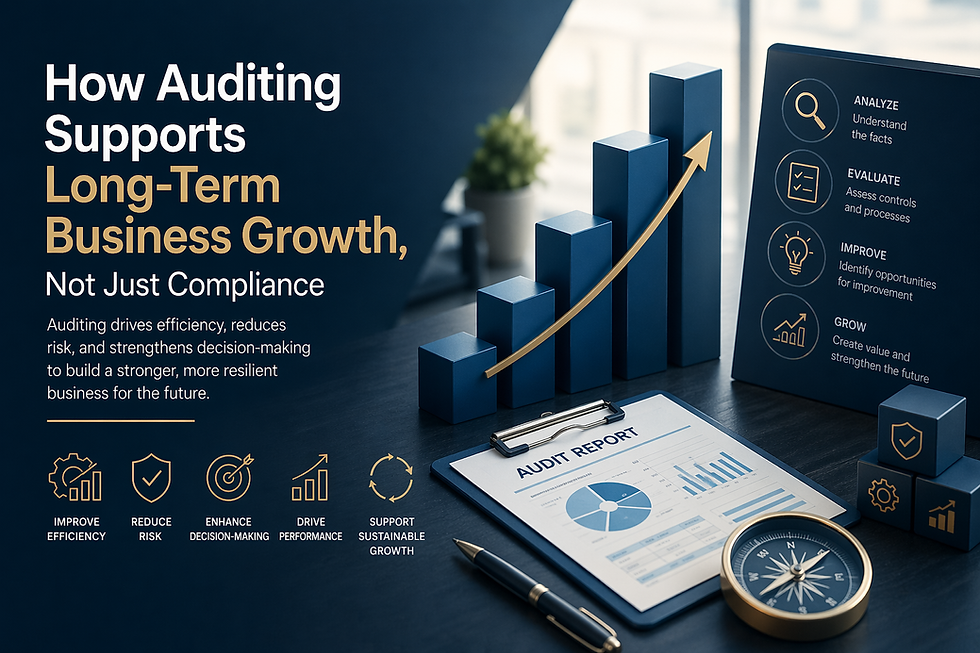
In many organizations, auditing is still seen mainly as a control function. It is often associated with checklists, documents, and the question of whether rules were followed correctly. While compliance remains an important part of any audit, this view is too narrow for the needs of modern business. Strong auditing does more than confirm that requirements are being met. It helps organizations improve efficiency, reduce avoidable risk, strengthen internal discipline, and make better decisions over time.
From an inspection body perspective, auditing should be understood as a practical tool for long-term development. It creates a clearer picture of how work is actually being done, where resources are being used well, and where processes can be improved. This turns auditing into a source of business intelligence, not just a formal procedure.
One of the clearest ways auditing supports growth is by improving operational efficiency. Many organizations develop routines over time that once made sense but no longer serve the business well. Departments may duplicate tasks, approvals may take too long, reporting lines may be unclear, or information may move too slowly between teams. These issues are not always visible from day to day because staff become used to them. A good audit helps bring these patterns into focus. By examining workflows carefully and objectively, auditing can identify unnecessary complexity and encourage simpler, more reliable methods of working.
This matters because efficient organizations are usually better prepared to grow. When internal systems are strong, expansion becomes less risky. New projects can be introduced more smoothly, leadership can delegate with greater confidence, and teams can perform with fewer disruptions. In this sense, auditing supports scalability. It helps organizations build structures that can handle future demands, not only current ones.
Auditing also contributes directly to risk reduction. Every growing business faces risk, whether financial, operational, strategic, or reputational. Some risks come from weak documentation. Others come from poor communication, inconsistent controls, or decision-making based on incomplete information. Auditing helps reduce these vulnerabilities by testing whether systems are functioning as intended and whether gaps exist between policy and practice.
This is especially important in periods of change. When businesses adopt new technologies, enter new markets, restructure teams, or introduce new services, complexity increases. Without disciplined review, small weaknesses can become larger problems. Auditing offers a structured way to examine whether the organization is ready, whether controls remain effective, and whether management has reliable visibility over what is happening inside the business. That kind of insight supports resilience, which is essential for long-term growth.
Another important contribution of auditing is its effect on decision-making. Leadership works best when decisions are based on facts rather than assumptions. Auditing helps provide that factual foundation. It can show whether reported performance reflects real conditions, whether procedures are being applied consistently, and whether management information is trustworthy. This allows leaders to act with greater confidence.
In many cases, audit findings do not simply point out problems. They highlight patterns. They show where performance is strong, where processes are stable, and where improvements will have the greatest impact. This can help leaders decide where to invest, which functions need reinforcement, and which reforms should be prioritized first. Over time, such disciplined decision-making supports stronger business performance.
There is also an important cultural dimension. Organizations that treat auditing positively often build a stronger culture of accountability and continuous improvement. When audits are approached as constructive evaluations rather than punitive exercises, staff are more likely to engage honestly, managers are more open to refinement, and improvement becomes part of daily professional life. This creates a healthier operational environment. Teams understand expectations more clearly. Responsibilities become easier to follow. Trust in systems grows.
For an independent inspection body, this is where auditing creates real value. It is not only about identifying nonconformities. It is about helping organizations understand themselves more clearly. It is about supporting disciplined growth, practical improvement, and stronger performance over time. Businesses that use auditing well do not wait for problems to become visible from the outside. They build internal clarity early, act on evidence, and strengthen their foundations before weaknesses become costly.
In today’s environment, competitive advantage does not come only from ambition or speed. It also comes from control, consistency, and informed leadership. Auditing supports all three. When understood in this wider way, it becomes more than a compliance activity. It becomes part of a long-term business strategy.
For organizations that aim to grow sustainably, auditing should not be viewed as a burden. It should be recognized as a valuable management tool that supports quality, confidence, and continuous progress. This is where auditing moves beyond obligation and begins to contribute directly to long-term success.
Hashtags:
Comments